
CNC machines have transformed modern manufacturing by delivering high precision, speed, and consistency. CNC stands for Computer Numerical Control, which means machines are controlled by computer software rather than manual operation.
In this article, we’ll explain how CNC machines work step by step, from design to finished product.
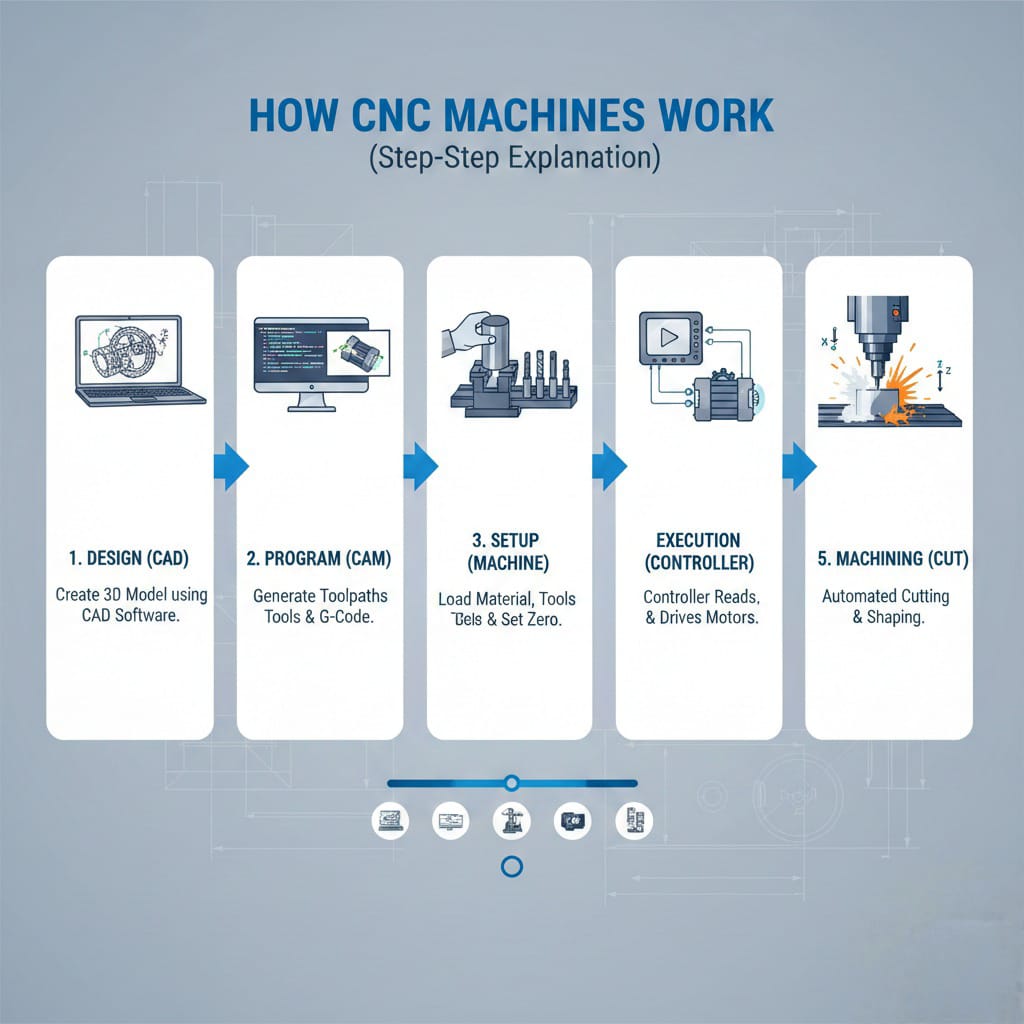
What Is a CNC Machine?
A CNC machine is a computer-controlled machine used to cut, shape, drill, or engrave materials such as metal, wood, plastic, and acrylic. Instead of being operated by hand, CNC machines follow pre-programmed instructions to perform precise movements.
Step 1: Creating the Design (CAD)
The CNC process starts with a CAD (Computer-Aided Design) file.
- Designers create a 2D or 3D model of the part
- Software like AutoCAD, SolidWorks, or Fusion 360 is used
- The design includes exact dimensions, shapes, and tolerances
This digital design acts as the blueprint for the CNC machine.
Step 2: Converting the Design into CNC Code (CAM)
Once the design is ready, it is imported into CAM (Computer-Aided Manufacturing) software.
- CAM software converts the design into G-code
- G-code is a machine language that tells the CNC machine:
- Where to move
- How fast to move
- When to cut, drill, or stop
Without this code, the CNC machine cannot operate.
Step 3: Setting Up the CNC Machine
Before machining begins, the operator prepares the machine:
- Material is securely placed on the machine bed
- Cutting tools are installed (drill bits, end mills, etc.)
- Machine zero point (origin) is set
- The correct program is loaded into the machine
Proper setup ensures accuracy and prevents errors.
Step 4: Machine Calibration and Tool Check
Calibration is essential for precision.
- The machine checks tool length and position
- Spindle speed and feed rate are adjusted
- Safety checks are performed
This step ensures the CNC machine follows the program exactly.
Step 5: CNC Machining Process Begins
Once everything is ready, the machine starts working automatically.
- The spindle rotates the cutting tool
- The machine moves along X, Y, and Z axes
- Material is removed layer by layer
- The process continues until the part is fully shaped
CNC machines can work continuously with minimal human intervention.
Step 6: Monitoring and Quality Control
Although CNC machines are automated, monitoring is still important.
- Operators observe the process for any issues
- Measurements are checked during or after machining
- Adjustments are made if required
This ensures high accuracy and consistent quality.
Step 7: Finishing the Final Product
After machining is complete:
- The finished part is removed
- Sharp edges may be smoothed
- Surface finishing or coating may be applied
- Final inspection ensures quality standards are met
The part is now ready for use or assembly.
Why CNC Machines Are So Accurate
CNC machines offer exceptional accuracy because:
- Movements are computer-controlled
- Human errors are minimized
- Repetitive tasks produce identical results
- Advanced software ensures precision
This makes CNC machining ideal for industrial and custom projects.
Applications of CNC Machines
CNC machines are widely used in:
- Automotive manufacturing
- Furniture and wood cutting
- Metal fabrication
- Signage and acrylic cutting
- Industrial equipment production
Why Choose CNC Machining?
CNC machining offers many advantages:
- High precision and consistency
- Faster production time
- Cost-effective for large quantities
- Ability to create complex designs
Conclusion
CNC machines work by combining digital design, computer programming, and automated machining. From creating a CAD design to producing a finished part, every step is controlled for accuracy and efficiency.
At PrimeX CNC, advanced CNC technology ensures reliable, high-quality machining solutions for a wide range of industries.