
When it comes to manufacturing and metal fabrication, two common methods are CNC machining and manual machining. While both are used to shape and cut materials, they differ greatly in accuracy, speed, and efficiency.
In this article, we’ll clearly explain the difference between CNC and manual machining to help you choose the right option for your project.
What Is CNC Machining?
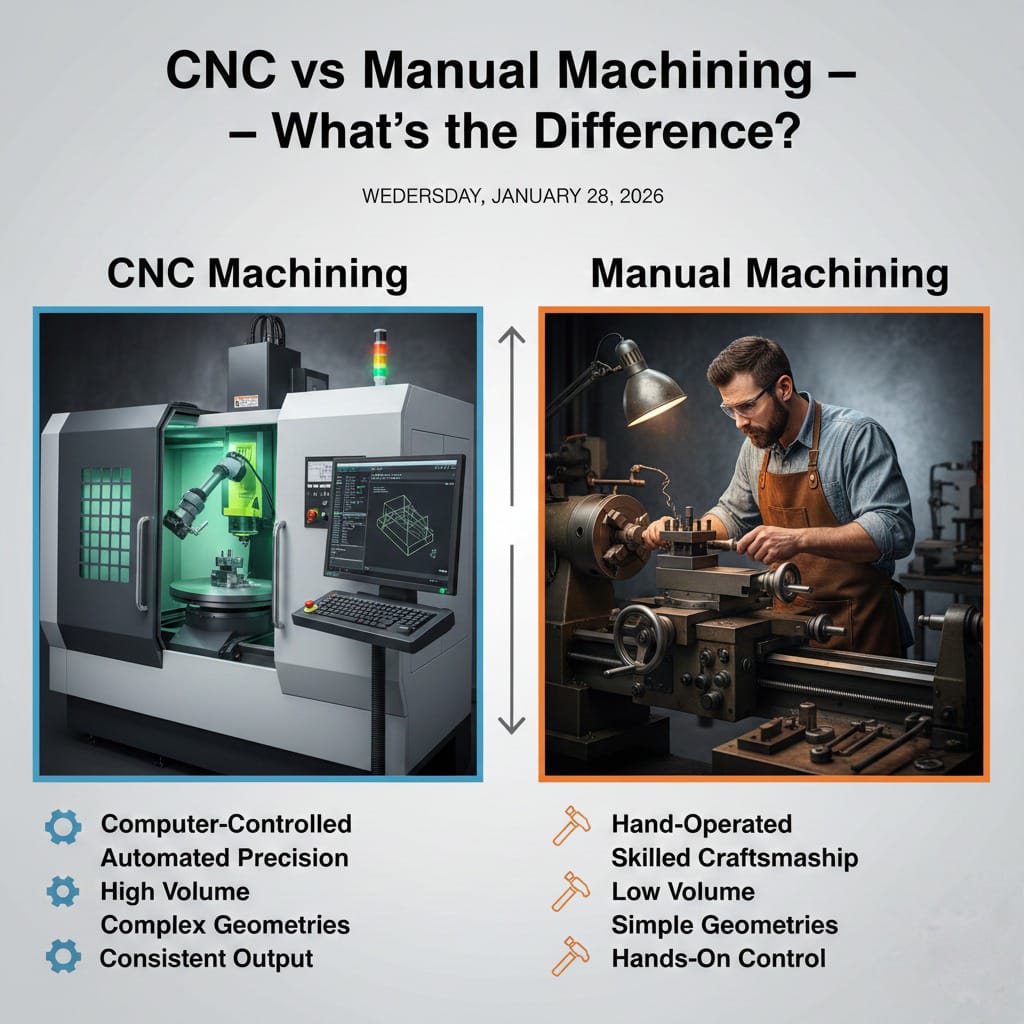
CNC machining (Computer Numerical Control) uses computer-programmed instructions to control machine movements.
- Operated through software (G-code)
- Minimal human intervention during operation
- Delivers highly accurate and repeatable results
CNC machining is widely used in industrial and large-scale manufacturing.
What Is Manual Machining?
Manual machining is operated by hand using levers, wheels, and controls.
- Requires constant operator involvement
- Machining depends on the operator’s skill
- Commonly used in workshops and small-scale jobs
Manual machines include traditional lathes, mills, and drills.
Key Differences Between CNC and Manual Machining
1. Precision and Accuracy
CNC Machining
- Extremely high precision
- Consistent results every time
- Ideal for complex and tight-tolerance parts
Manual Machining
- Precision depends on operator skill
- Difficult to maintain consistency for repeated parts
2. Speed and Efficiency
CNC Machining
- Faster production
- Can run continuously
- Ideal for bulk manufacturing
Manual Machining
- Slower process
- Requires frequent adjustments
- Best for small or one-off projects
3. Complexity of Design
CNC Machining
- Handles complex and detailed designs easily
- Supports multi-axis machining
Manual Machining
- Limited to simple shapes
- Complex designs are difficult and time-consuming
4. Labor and Skill Requirement
CNC Machining
- Requires programming knowledge
- Less physical effort once set up
Manual Machining
- Requires highly skilled machinists
- Physically demanding and time-intensive
5. Cost Comparison
CNC Machining
- Higher initial setup cost
- Lower cost per part in mass production
Manual Machining
- Lower initial cost
- Higher labor cost over time
CNC vs Manual Machining – Comparison Table
| Feature | CNC Machining | Manual Machining |
|---|---|---|
| Control Method | Computer-controlled | Hand-operated |
| Precision | Very High | Medium |
| Speed | Fast | Slow |
| Design Complexity | Complex | Simple |
| Labor Requirement | Low | High |
| Best For | Mass production | Small projects |
When to Choose CNC Machining
Choose CNC machining if:
- You need high precision
- You require large quantities
- Your design is complex
- Consistency is critical
When to Choose Manual Machining
Manual machining is suitable if:
- You need a quick one-off part
- Budget is limited
- The design is simple
- Custom adjustments are required
Why CNC Machining Is the Modern Choice
CNC machining offers:
- Better accuracy
- Faster turnaround time
- Reduced material waste
- Scalable production
That’s why industries worldwide prefer CNC machining for professional manufacturing.
Conclusion
Both CNC and manual machining have their place. Manual machining works well for small, simple jobs, while CNC machining is ideal for high-precision, large-scale, and complex projects.
At PrimeX CNC, advanced CNC technology ensures accurate, efficient, and reliable machining solutions for every industry.