
When choosing a CNC machining process, two of the most common options are CNC milling and CNC turning. While both are computer-controlled and highly precise, they are designed for different types of parts and applications.
In this article, we’ll explain the difference between CNC milling and CNC turning to help you decide which one is right for your project.
What Is CNC Milling?
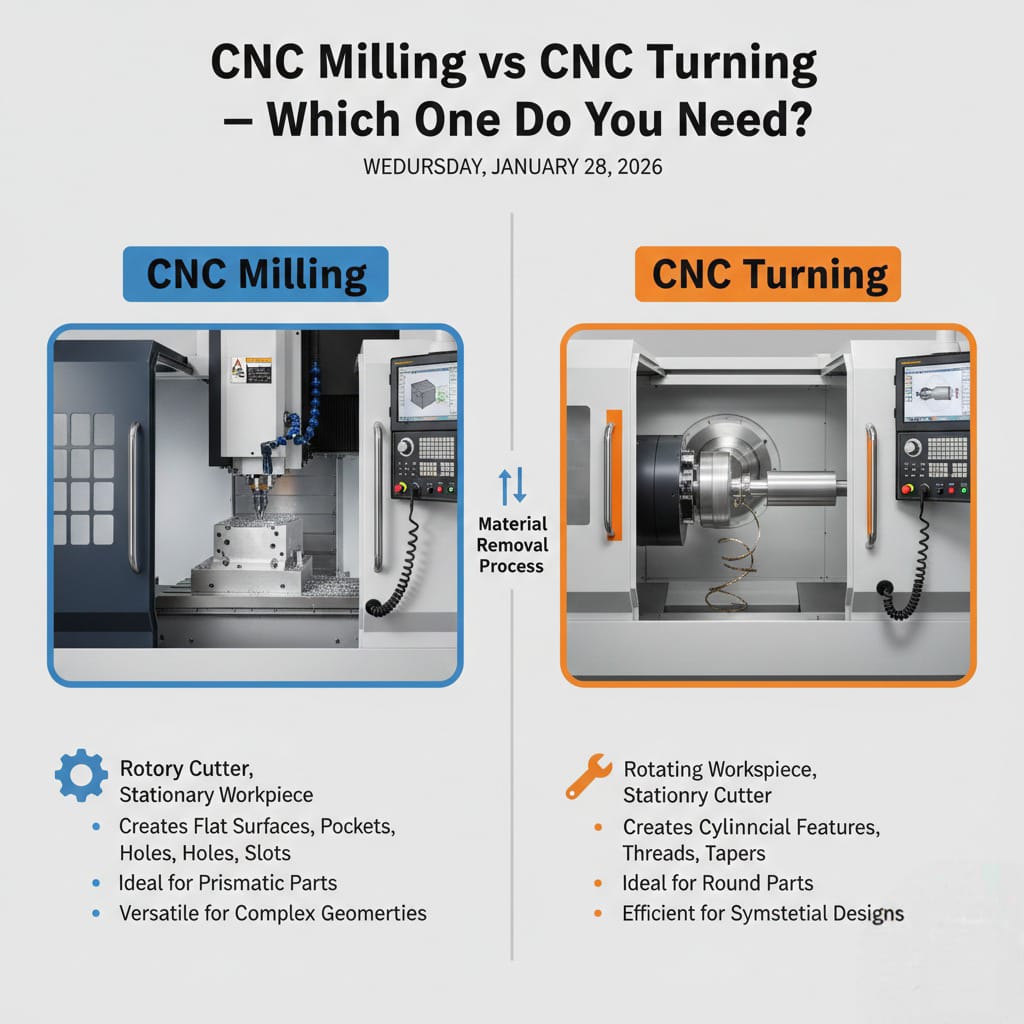
CNC milling is a machining process where a rotating cutting tool removes material from a stationary workpiece.
How CNC Milling Works
- Cutting tool rotates at high speed
- Workpiece remains fixed on the machine bed
- Machine moves along multiple axes (X, Y, Z, and more)
- Creates complex shapes and detailed features
Best Uses for CNC Milling
- Complex and non-symmetrical parts
- Slots, pockets, and holes
- Mold and die components
- Automotive and industrial parts
Advantages of CNC Milling
- Extremely high precision
- Ideal for complex geometries
- Multi-axis capabilities
What Is CNC Turning?
CNC turning is performed on a CNC lathe, where the workpiece rotates and the cutting tool remains mostly stationary.
How CNC Turning Works
- Material rotates on a spindle
- Cutting tool shapes the material
- Best for round or cylindrical components
Best Uses for CNC Turning
- Shafts and rods
- Bushings and fittings
- Pipes and tubes
- Symmetrical components
Advantages of CNC Turning
- Faster production speed
- Excellent surface finish
- Cost-effective for large quantities
Key Differences Between CNC Milling and CNC Turning
Movement
- Milling: Tool rotates, material stays still
- Turning: Material rotates, tool stays still
Part Shape
- Milling: Complex, irregular shapes
- Turning: Round or cylindrical shapes
Production Speed
- Milling: Slower for simple parts
- Turning: Faster for symmetrical parts
CNC Milling vs CNC Turning – Comparison Table
| Feature | CNC Milling | CNC Turning |
|---|---|---|
| Machine Type | CNC Mill | CNC Lathe |
| Workpiece Movement | Stationary | Rotating |
| Tool Movement | Rotating | Stationary |
| Part Shape | Complex | Cylindrical |
| Precision | Very High | High |
| Production Speed | Medium | Fast |
Which One Do You Need?
Choose CNC milling if:
- Your design has complex shapes
- You need slots, pockets, or detailed features
- Parts are non-cylindrical
Choose CNC turning if:
- Your part is round or symmetrical
- You need fast production
- Surface finish is critical
Can You Use Both?
Yes! Many projects require both CNC milling and CNC turning.
For example:
- Turning creates the basic round shape
- Milling adds slots, holes, or keyways
At PrimeX CNC, both processes are combined to deliver complete machining solutions.
Conclusion
CNC milling and CNC turning serve different purposes. Milling is ideal for complex designs, while turning excels at producing round, symmetrical parts quickly and efficiently.
Understanding your part design is the key to choosing the right process.