
CNC machines come in different types, each designed for specific cutting and manufacturing tasks. Choosing the right CNC machine depends on the material, design complexity, and production requirements.
In this article, we explain the main types of CNC machines—CNC Milling, CNC Turning, CNC Laser Cutting, and CNC Plasma Cutting—and how each one works.
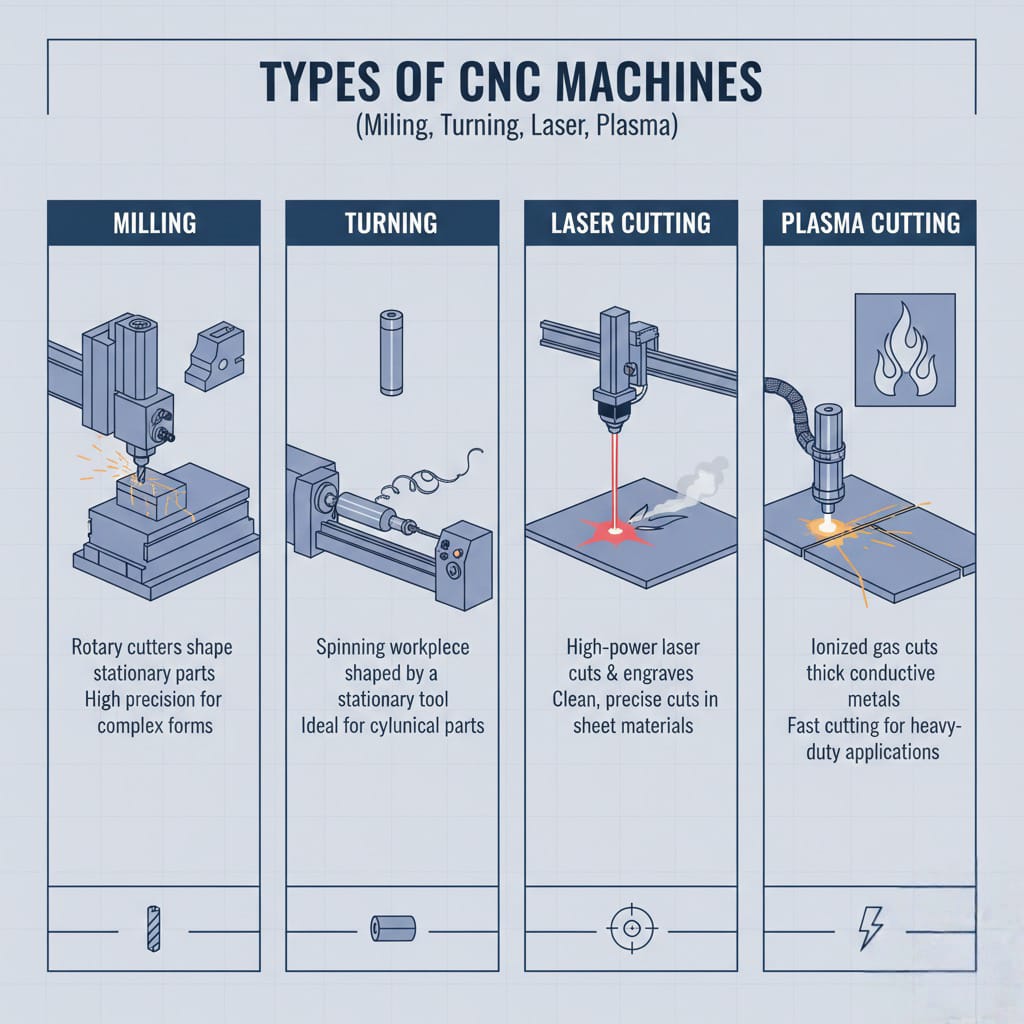
1. CNC Milling Machines
CNC milling machines are among the most widely used CNC machines in manufacturing.
How CNC Milling Works
- A rotating cutting tool removes material from a stationary workpiece
- The machine moves along X, Y, and Z axes
- Capable of producing complex shapes and precise details
Common Applications
- Metal and aluminum parts
- Mold and die making
- Automotive and aerospace components
- Industrial machinery parts
Key Advantages
- High precision and accuracy
- Ideal for complex designs
- Supports multi-axis machining
2. CNC Turning Machines (CNC Lathe)
CNC turning machines are designed for round or cylindrical parts.
How CNC Turning Works
- The workpiece rotates on a spindle
- A stationary cutting tool shapes the material
- Ideal for symmetrical components
Common Applications
- Shafts and rods
- Bushings and fittings
- Pipes and fasteners
- Mechanical components
Key Advantages
- Fast production speed
- Excellent surface finish
- High consistency for mass production
3. CNC Laser Cutting Machines
CNC laser machines use a high-powered laser beam to cut or engrave materials.
How CNC Laser Cutting Works
- A focused laser melts or vaporizes material
- Computer control ensures precise cuts
- Minimal material waste
Common Applications
- Acrylic and plastic cutting
- Sheet metal fabrication
- Signage and branding
- Decorative panels
Key Advantages
- Extremely precise cutting
- Clean edges with no physical contact
- Ideal for thin and delicate materials
4. CNC Plasma Cutting Machines
CNC plasma cutting machines are used for heavy-duty metal cutting.
How CNC Plasma Cutting Works
- Ionized gas (plasma) cuts through conductive metals
- Controlled by CNC software for accuracy
- Works best on thick metal sheets
Common Applications
- Structural steel fabrication
- Industrial construction
- Automotive repair
- Heavy machinery parts
Key Advantages
- High cutting speed
- Cost-effective for thick metals
- Suitable for large-scale industrial work
Comparison of CNC Machine Types
| CNC Machine Type | Best For | Materials | Precision Level |
|---|---|---|---|
| CNC Milling | Complex shapes | Metal, plastic | Very High |
| CNC Turning | Cylindrical parts | Metal | High |
| CNC Laser | Thin materials | Acrylic, metal | Very High |
| CNC Plasma | Thick metals | Steel, aluminum | Medium–High |
How to Choose the Right CNC Machine
When selecting a CNC machine, consider:
- Type of material
- Design complexity
- Required precision
- Production volume
- Budget and time constraints
At PrimeX CNC, experts help you choose the right CNC solution based on your project needs.
Conclusion
Each type of CNC machine serves a unique purpose. CNC milling is ideal for complex designs, CNC turning excels at cylindrical parts, laser cutting offers unmatched precision, and plasma cutting handles heavy-duty metal fabrication.
Understanding these CNC machine types helps businesses make informed manufacturing decisions.